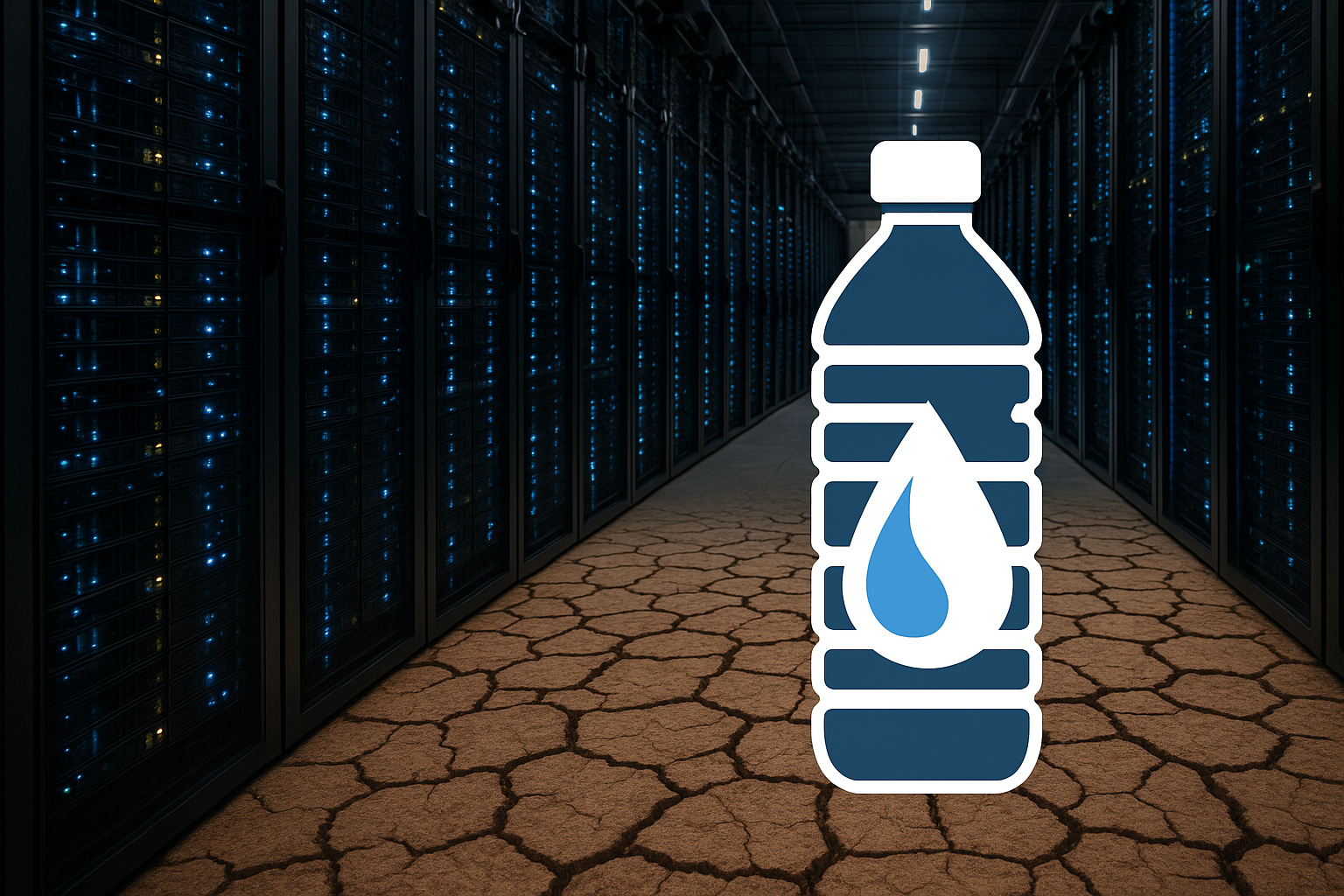
Key Takeaway
Every AI query consumes water and energy. With 1 billion+ daily ChatGPT queries, AI data centers now emit more CO2 than the aviation industry. Discover the hidden environmental cost of AI and what leaders can do about it.
The Invisible Cost
Every time you ask ChatGPT a question, something happens that you can't see.
Thousands of miles away, servers spin up in massive data centers. Cooling systems pump water to prevent overheating. Electricity flows through processors working at incredible speeds. And somewhere, a power plant burns fuel to keep it all running.
That simple query—"What's a good recipe for dinner?"—just consumed resources. Not much for one question. But multiply it by 1 billion daily queries, and suddenly we're talking about an environmental footprint that rivals entire industries.
This is AI's hidden thirst. And it's growing exponentially.
A Sobering Comparison
AI data centers now emit more CO2 than the entire aviation industry. While planes carry billions of passengers across the globe, our digital conversations are quietly generating 105+ million metric tons of carbon dioxide annually.
The Numbers That Should Concern You
Let's ground this in data. According to MIT News research and the International Energy Agency, here's what AI really costs:
Energy Consumption: The Scale
| Metric | Current (2025) | Projected (2030) |
|---|---|---|
| Global AI Electricity | 415-500 TWh | 945 TWh |
| Share of Global Power | ~2% | ~3% |
| U.S. Data Center Capacity | 5 GW | 50+ GW |
| Annual Growth Rate | 15% | 15% |
To put 500 TWh in perspective: that's more electricity than many countries consume in a year. If AI were a country, it would rank among the top 15 electricity consumers globally—somewhere between Saudi Arabia and France.
Training vs. Inference: Where the Energy Goes
Here's what surprises most people: training those massive AI models isn't the biggest energy drain anymore.
According to MIT researchers, a single ChatGPT query consumes approximately five times more electricity than a simple web search. That might seem small—until you multiply it by billions of daily interactions.
A generative AI training cluster might consume seven or eight times more energy than a typical computing workload.
The Water Crisis
Energy is only half the story. AI has a thirst—literally.

Data centers require massive cooling systems to prevent servers from overheating. Most use water—lots of it. According to research from UC Riverside, here's the water reality:
The Per-Query Impact
- Single ChatGPT query: ~0.32 milliliters of water
- 1 billion daily queries: 320,000 liters collectively
- Google's Iowa facility alone: 1 billion gallons annually
The Water Bottle Analogy
Research estimates that a conversation of 20-50 AI exchanges consumes roughly 500ml of water—about one standard water bottle. That water is used for cooling and often evaporates, contributing to local water stress in regions where data centers operate.
Corporate Water Footprints
The tech giants' water usage has surged with AI adoption:
| Company | Water Increase | Primary Cause |
|---|---|---|
| Microsoft | +34% | Azure AI infrastructure expansion |
| +20% | AI model training and inference | |
| Combined Tech (2022) | 580 billion gallons | Total sector consumption |
Researchers project that by 2027, AI will withdraw between 4.2-6.6 billion cubic meters of water—greater than half the total water withdrawal of the United Kingdom.
The Carbon Equation

Every kilowatt-hour of electricity generates carbon emissions (unless it comes from renewables). Here's AI's carbon reality according to Climate Impact Partners and Carbon Brief:
Current Emissions
| Metric | Value | Context |
|---|---|---|
| Annual AI Emissions | 105+ million metric tons CO2 | Growing 15% yearly |
| GPT-4 Training | 12,456-14,994 metric tons CO2 | ~300 NYC-SF flights |
| GPT-3 Training | 552 tons CO2 | Powering 120 homes for a year |
| ChatGPT Monthly | 260,930 kg CO2 | 260 transatlantic flights |
The Dirty Secret: Grid Carbon Intensity
Here's what the corporate sustainability reports don't emphasize: the carbon intensity of electricity used by data centers is 48% higher than the U.S. average. Why? Many data centers are located where electricity is cheap—which often means coal-heavy grids.
The 60% Problem
According to Goldman Sachs Research, approximately 60% of increasing data center electricity demand will be met by burning fossil fuels, adding an estimated 220 million tons to global carbon emissions.
The 3 AM Carbon Penalty
Here's a finding that surprised researchers: when you use AI matters almost as much as how much you use it.
Late-night AI queries emit 67% more CO2 than daytime queries. The reason: reduced renewable energy availability on the grid. During the day, solar contributes significantly. At 3 AM, fossil fuels dominate.
Splitting computing operations so some are performed later, when more of the electricity fed into the grid is from renewable sources like solar and wind, can go a long way toward reducing a data center's carbon footprint.
Who's Responsible?
The AI industry has a transparency problem. According to MIT Technology Review:
Major AI models like OpenAI's ChatGPT, Google's Gemini, and Anthropic's Claude are "closed" systems where key details about energy consumption are held closely by the companies. These companies face few incentives to release this information.
Corporate Pledges vs. Reality
| Company | Pledge | Reality |
|---|---|---|
| Microsoft | Carbon-negative by 2030 | Emissions increased 29% (2020-2024) |
| Net-zero by 2030 | ~60% renewable for new AI facilities | |
| Amazon | Net-zero by 2040 | 50-70% actual renewable deployment |
| Apple | 100% renewable data centers | Achieved (smallest AI footprint) |
The gap between pledges and performance is significant. While companies target 70-90% renewables, actual AI workload coverage hovers around 40-60%.
The Path Forward
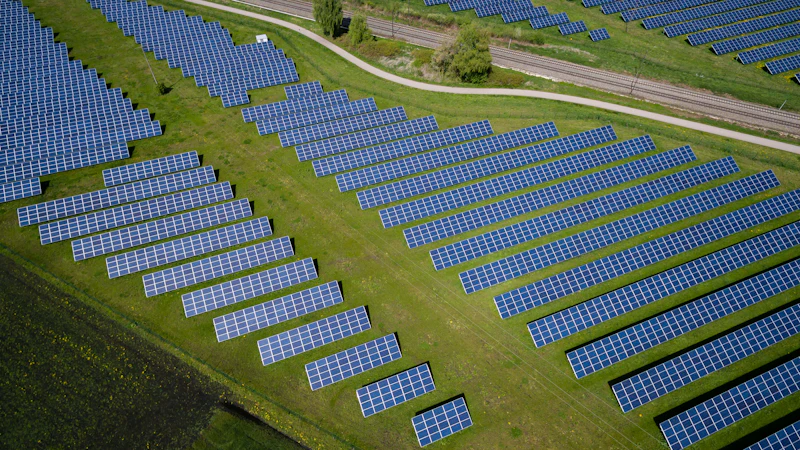
It's not all doom. The industry is innovating, and the Green AI Data Center Market is projected to reach $123 billion by 2035. Here's what's working:
Technological Solutions
Advanced Cooling Systems
Liquid and immersion cooling reduce energy needs by 30-50%. Google's DeepMind algorithms have cut cooling energy by 40%.
More Efficient Chips
NVIDIA reports a 24% reduction in embodied carbon between HGX H100 and HGX B200. Their accelerated computing is 100,000x more efficient than a decade ago.
Renewable Co-location
Companies like Soluna Computing place data centers directly at renewable power plants, accessing curtailed energy that would otherwise be wasted.
Carbon-Aware Computing
Microsoft Azure's 'carbon-aware load balancer' schedules tasks to regions with excess renewable energy, reducing carbon intensity.
Novel Architectures
Microsoft's underwater data center (117 feet below sea level) uses seawater cooling. Mass timber construction reduces embodied carbon by 65%.
Efficiency Gains: A Bright Spot
DeepSeek's Breakthrough
DeepSeek-V3 required only 2.8 GWh for training—95% more efficient than comparable models. This proves that efficiency innovation can dramatically reduce AI's footprint without sacrificing capability.
Future Scenarios (2030)
| Scenario | Global Emissions Share | Renewable Coverage |
|---|---|---|
| Optimistic | 0.8-1.0% | 95%+ |
| Base Case | 1.5-2.0% | 70-80% |
| Pessimistic | 3.0-4.0% | Stalled adoption |
What Leaders Can Do
This isn't just an environmental issue—it's a leadership issue. As someone who works across Climate-Tech and Digital Transformation, I've seen how organizations can make meaningful choices:
For Technology Leaders
Do This
- Choose cloud providers with verified renewable energy commitments
- Implement carbon-aware scheduling for batch AI workloads
- Right-size AI usage—not every task needs GPT-4
- Measure and report your AI carbon footprint
- Advocate for industry transparency standards
Avoid This
- Ignoring AI's environmental cost in vendor selection
- Running energy-intensive training jobs during peak fossil fuel hours
- Using maximum-capability models for simple tasks
- Treating sustainability as someone else's problem
- Accepting corporate pledges without verification
For Project Managers
When evaluating AI implementations:
- Include environmental cost in ROI calculations—not just compute costs
- Question default model choices—smaller models often suffice
- Schedule intensive workloads strategically—align with renewable availability
- Track and report AI energy consumption—what gets measured gets managed
- Build sustainability into requirements—make it a selection criterion
For Individual Users
Even individual choices add up across billions of users:
- Be intentional with queries—avoid casual, repetitive AI usage
- Use appropriate tools—not everything needs a large language model
- Consider timing—daytime queries have lower carbon intensity
- Support transparent providers—vote with your usage
- Stay informed—awareness drives better decisions
Bottom Line
Key Takeaways
- 1AI consumes 500 TWh annually—2% of global electricity—and growing 15% yearly
- 2Data center emissions (105M+ tons CO2) now exceed the aviation industry
- 3Water usage is surging: U.S. data centers could use 34-68 billion gallons by 2028
- 460-70% of AI energy now goes to inference (daily queries), not training
- 5Late-night queries emit 67% more CO2 due to reduced renewable availability
- 6Despite pledges, only 40-60% of AI workloads run on actual renewable energy
- 7Solutions exist: efficient chips, renewable co-location, carbon-aware computing
- 8Leaders must include environmental cost in AI decision-making—it's a responsibility, not an option
AI is transforming how we work, create, and solve problems. That transformation has value. But it also has cost—measured in terawatt-hours, billions of gallons of water, and millions of tons of carbon.
The question isn't whether to use AI. It's how to use it responsibly.
As leaders, we have choices. We can demand transparency from providers. We can factor environmental cost into our decisions. We can advocate for better standards. We can choose efficiency over convenience.
The AI industry is at an inflection point. The decisions made in the next few years will determine whether artificial intelligence becomes part of the climate solution—or accelerates the problem.
What role will you play?
References & Further Reading
- MIT News: Explained - Generative AI's Environmental Impact
- MIT Technology Review: AI's Energy Footprint
- Carbon Brief: AI and Data Centre Energy in Context
- All About AI: Environment Statistics 2025
- Climate Impact Partners: Carbon Footprint of AI
- UNEP: AI Has an Environmental Problem
- Precedence Research: Green AI Data Center Market